Free ROI Calculator

Discover How Fast a Jewelry Laser Welder Pays for Itself

Stop guessing. Use our free, data-driven calculator to see your exact savings, payback period, and 5-year profit potential from switching to laser welding.


A jewellery repair bench in low warm light with rings, a fine chain and tweezers on a dark pad
Your Numbers
Your Payback
Assumption
Based Model
Outsourcing
Cost Comparison
Editable
Assumptions

The Numbers That Matter Depend on Who You Are

A repair counter, a retail chain and a production floor are not measuring the same thing, so the payback question is not the same question. Find the description closest to your operation before you read the result.

Bench inside a retail jewellery repair shop
Repair Shop & Retail Jeweler

What you are measuring

What outsourcing costs you today, and how quickly bringing that work back in-house covers the machine. Reduced outsourcing and retained repair revenue are the two levers.

Staff handing a ring box across a jewellery store service counter
Retail Chain & After-Sales

What you are measuring

Whether a standardised repair capability across branches lifts after-sales revenue — the calculation runs per location, not once for the group.

Jewellery production floor with several benches
Production Team & Manufacturer

What you are measuring

Output against rework and scrap. Here the return shows up as fewer pieces written off and less labour spent redoing them, rather than as outsourcing saved.

Four Figures You Already Have

The calculator does not ask you to estimate anything about the machine. Every input is a number from your own books, which is the only reason the output means anything.

Go to the calculator
Monthly outsourced repairs
How many jobs currently leave your bench. This sets the size of the opportunity — everything else scales off it.
Average cost per outsourced job
What the trade bench charges you. This is the cost that stops being paid once the work stays in-house.
Average charge to your customer
What the same repair is worth on your counter. The gap between these two rows is the revenue you are currently handing over.
Equipment budget
Entered as a tier range rather than a fixed figure, because configuration — optics, cooling, chamber — moves the price within any tier.
Four figures in, one range out
The four inputs and what the calculator returns Four boxes on the left, each one a figure from your own books, feed into the calculator in the middle, which returns a payback range rather than a single date. Monthly outsourced repairs Average cost per outsourced job Average charge to your customer Equipment budget (a tier range) The calculator your figures only A payback range for your shop, not an average Nothing is pre-filled, and no industry average is substituted where you leave a gap.
Every arrow starts at a number already in your books. That is the only reason the output means anything — the calculator asks you to estimate nothing about the machine itself.

What This Calculation Assumes

A payback figure is only as honest as the assumptions under it. These are ours, stated plainly so you can decide whether they hold for your shop.

  • It runs entirely on the volume and values you enter. Nothing is filled in for you, and no industry average is substituted where you leave a gap.
  • It assumes the work you currently outsource can be brought in-house. Some of it may not be — stone-set and treated pieces are assessed individually before welding.
  • It assumes an operator is producing sellable results. Ramp-up time varies by team, and the calculator does not model it.
  • It assumes steady monthly volume. If your repair intake is seasonal, run it twice — once on a strong month and once on a slow one — and read the two results as a range.
  • There is no payback period that applies to every buyer. Utilisation, job mix and pricing differ enough between shops that a headline figure would be misleading rather than helpful.

What the Result Does and Does Not Include

Knowing the edges of a calculation is worth as much as the number itself.

Counted in the result
  • Outsourcing cost that stops being paid
  • Repair revenue that stays on your counter instead of being shared
  • The equipment figure you entered
Not counted — ask for these separately
  • Consumables and shielding gas, which depend on your job mix
  • Servicing and spare parts over the machine's life
  • Operator time during ramp-up, before output is routine
  • Financing, if the purchase is not outright

These are left out because they vary too much between shops to guess at. Ask and they will be quoted against your configuration rather than estimated here.

Jewelry Laser Welder ROI Calculator

Enter your shop's numbers below. We'll calculate your monthly savings, break-even point, and 5-year return instantly.

Enter Your Shop Details

All fields required for an accurate estimate

$
$
$
$
$
$

What a Payback Actually Looks Like

The calculator returns a number. This is the shape that number describes — worth reading before you decide what the number means.

The shape, not a forecast
How cumulative retained value crosses the equipment budget A rising straight line representing cumulative value retained each month crosses a flat horizontal line representing the equipment budget. The crossing is the payback point. The axes carry no numbers because the position of the crossing depends on figures you enter. Your equipment budget Cumulative value retained Your payback point everything after this is return Months in service → no scale on either axis — deliberately
There are no numbers on these axes, and that is the point. Where the crossing falls is decided entirely by the four figures you enter — your volume, what outsourcing costs you, what you charge, and your equipment budget. Any supplier printing a single payback period for every buyer is describing their averages rather than your shop.
The slope is your monthly saving
Higher volume or a bigger gap between what you pay a trade bench and what you charge makes the line steeper, and the crossing arrives sooner.
The flat line is your budget
Configuration moves it up or down within a tier — optics, cooling and chamber all sit on this line rather than on the slope.
Two shops, one machine, two crossings
The same model can pay back at very different points for two buyers. That is why the result is read against your own figures rather than compared with someone else's.
Seasonal intake? Run it twice
Once on a strong month and once on a slow one, and read the two crossings as a range rather than a date.

Why Jewelers Invest in Laser Welding

Beyond the numbers, a laser welder transforms how your shop operates.

Lower Cost Per Repair

Cut material waste and outsourcing fees by welding in-house at a fraction of the cost.

Faster Turnaround

Complete repairs in minutes instead of days, boosting customer satisfaction and repeat business.

Heat Held at the Joint

Weld near gemstones and delicate settings with the energy placed at the joint instead of spreading through the piece.

New Revenue Streams

Offer new services like prong retipping, custom fabrication, and same-day repairs.

Stronger, Cleaner Welds

Achieve professional-grade joints that hold up better than traditional torch soldering.

Fast Payback

How quickly it pays back is set by your own figures — how many repairs you currently send out, what that outsourcing costs you, and what you charge for the same work. Run those through the calculator above rather than a headline number.

The same repair, two routes
Sent out to a trade bench5 handovers
YouJob taken in at the counter
TransitPacked, insured, shipped out
Someone elseWaits in their queue, then welded
TransitShipped back, checked in
YouReturned to the customer
Done on your own bench3 handovers
YouJob taken in at the counter
YouAssessed and welded in-house
YouReturned to the customer
The two amber steps are the ones that disappear. We have deliberately put no days on this diagram — transit and queue times vary too much between shops and couriers to state honestly. What does not vary is that both legs stop existing, along with the margin split at the third step.
A jeweller packing a gold ring into a padded pouch and shipping box on a workshop bench

Every outsourced repair starts here. Packing, insuring and tracking a customer's ring is labour that never appears on a trade-bench invoice, which is why it rarely gets counted when the two routes are compared.

How the ROI Calculator Works

1
Enter Your Numbers

Input your machine cost, repair volume, and current expenses in the calculator above.

2
We Crunch the Data

Our formulas compare your current costs against projected laser welding costs and time savings.

3
Get Instant Results

See your monthly savings, payback period, and 5-year profit projection instantly.

4
Talk to an Expert

Ready to invest? Connect with our team to find the right laser welder for your shop.

An overhead view of a jeweller's intake tray holding rings, broken chains, a bangle and a pendant waiting for repair

Four Places the Return Actually Comes From

"It pays for itself" is not one effect but four, and which of them apply depends on whether you run a repair counter or a production floor.

Repair benches

Reduced outsourcing

Every job that stops leaving the building stops carrying a trade-bench invoice with it.

Repair benches

Retained repair revenue

The margin on that repair stays with you rather than being split with whoever did the work.

Production floors

Rework reduction

Fewer pieces going back through the process, and less labour spent putting them right.

Production floors

Scrap reduction

Castings with porosity or cracks repaired rather than written off and started again.

The calculator above models the first two. If rework and scrap are your bigger numbers, say so when you send your figures — those are quoted against your own reject rate rather than assumed.

The Metal You Work In Moves the Number

Conductivity, reflectivity and melting behaviour differ between precious metals, so each needs its own parameter set — and that shows up as different time per job, which is what a payback calculation is really counting.

Palladium, titanium and stainless steel are handled too, each with its own parameter set. There is no single setting correct across all of them, so a mixed-metal shop should read its payback as a range rather than a point.

A customer's own rings, chain and pendant laid out beside an open shipping box

Check the Assumption Before You Trust the Result

The whole calculation rests on one assumption: that the work you currently send out can be done on your own bench. That is worth testing rather than assuming.

Send an actual repair — one you would normally hand to a trade bench — and see the joint before any of these numbers matter. The test weld is free, the piece comes back, and nothing is attached to it.

Request a Free Welding Test Send your repair photos
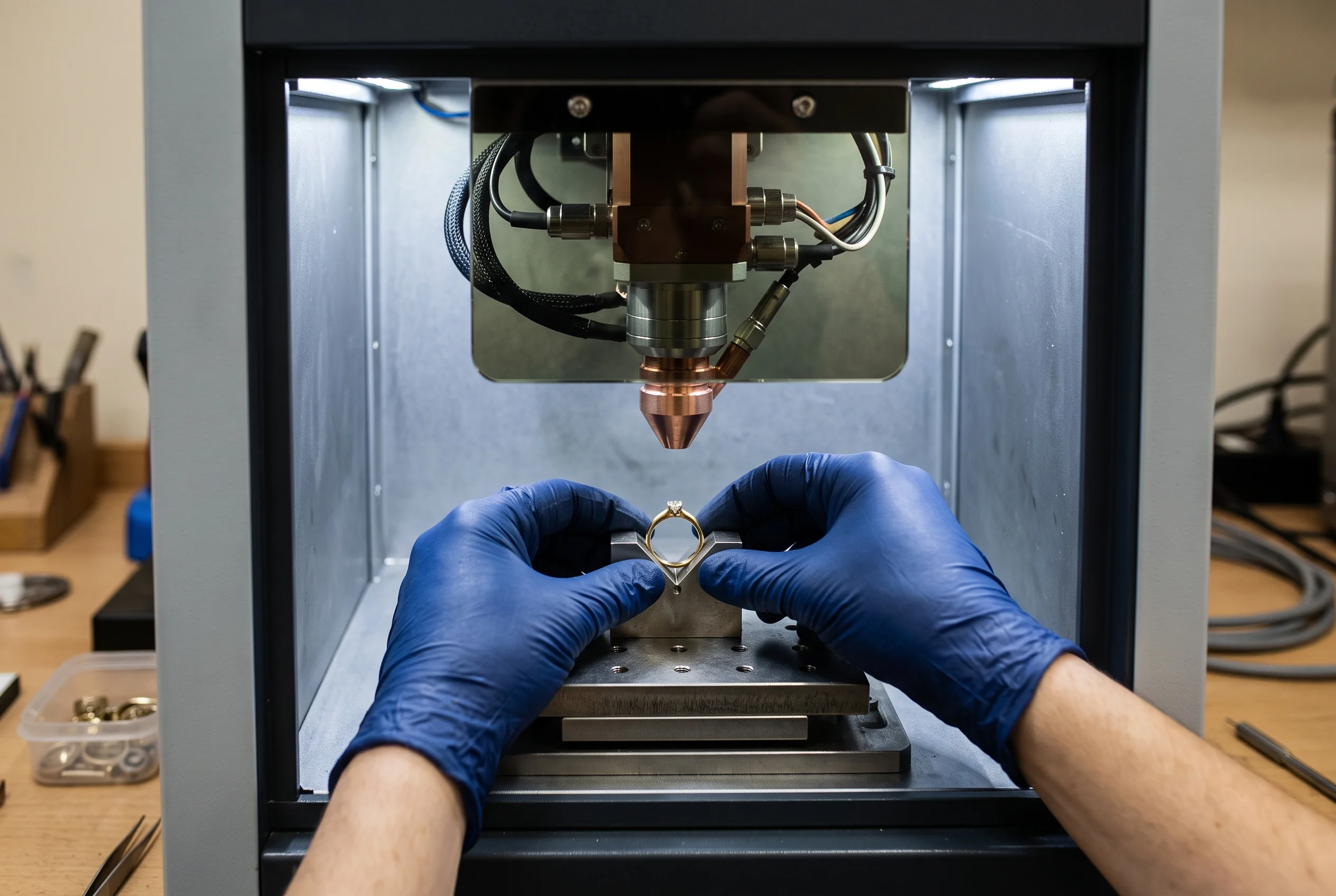
Gloved hands positioning a ring inside the working chamber of a jewellery laser welder

A Payback Figure Is Not Yet a Machine

The result tells you what the work is worth. It does not tell you which configuration does that work — those are chosen from workload and precision demand rather than from a budget line, and two shops with the same payback can need different machines.

So the next step is not a price list. Take the volume you just entered and set it against what each tier is built to carry.

Compare by workload What drives the cost
Your monthly volume
Decides whether an entry tier keeps up or becomes the bottleneck.
Your job mix
Stone-set and fine-detail work push toward a smaller spot and finer thermal control.
How many operators
More than one hand on the machine makes stored parameters worth more than peak figures.

Frequently Asked Questions

Everything you need to know about calculating ROI for jewelry laser welders.

The calculator uses the figures you provide to generate a realistic estimate based on standard industry cost structures. While actual results vary by shop, most users find their real-world numbers land within 10-15% of the estimate.

Use your best estimate. Many jewelers track their outsourcing invoices or torch soldering material costs to arrive at an average cost per repair. Even rough estimates give a useful directional result.

This version calculates ROI based on cash purchase price. If you're financing your laser welder, contact our team for a customized calculation that includes interest and monthly payment terms.

There isn't a typical one, and any figure quoted as typical is really describing somebody else's shop. The period falls out of four things that differ from bench to bench: how many repairs you currently send out, what that outsourcing costs you, what you charge for the same work, and how much of the week the machine would actually be running. Those four are exactly what the calculator above asks for — enter your own and read the result against the assumptions listed under it, including the ones the calculation deliberately leaves out.

Yes! After using the calculator, click "Talk to a Laser Welding Expert" to schedule a free consultation. We'll help match your shop's volume and budget with the right laser welder model.

Ready to See Your Exact Numbers?

Run the calculator now or speak directly with one of our laser welding specialists.