Can you use the same laser welding settings for 10K, 14K, and 18K gold?
No. Although all three can be laser welded, different gold alloys may require different pulse energy, pulse duration, spot size, and repair techniques.
The main difference is alloy composition.
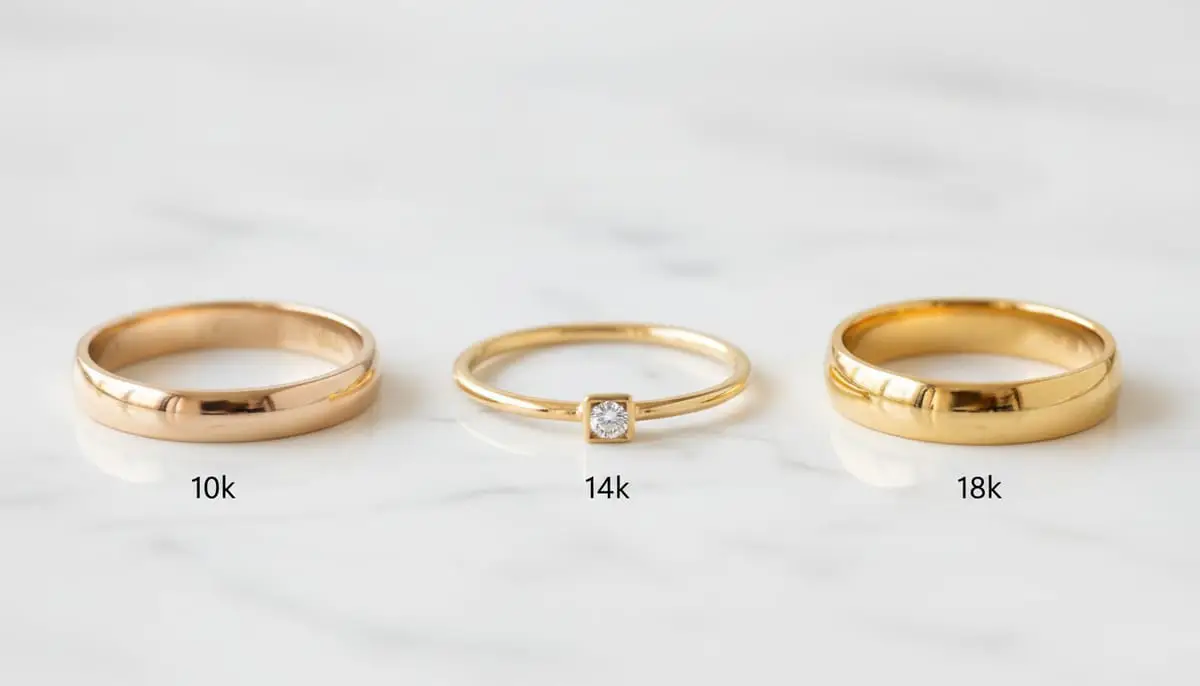
10K gold contains approximately 41.7% pure gold, 14K contains 58.3%, and 18K contains 75%. The remaining metals influence hardness, melting behavior, color, and susceptibility to certain welding defects.
However, higher gold purity does not automatically mean that the metal needs less laser energy.
A 14K nickel white gold ring may behave very differently from a 14K yellow gold ring. Likewise, a heavy 18K yellow gold shank may require more welding energy than a delicate 10K chain link.
For jewelers using a jewelry laser welder, the correct settings depend on the gold alloy, repair size, joint condition, and machine configuration.
Gold Type | Gold Content | Main Welding Consideration |
|---|---|---|
10K Gold | 41.7% | Alloying metals, oxidation, and filler color matching |
14K Gold | 58.3% | Adjusting settings between everyday repair types |
18K Gold | 75% | Alloy-dependent cracking, reflectivity, and delicate edges |
The best approach is to identify the actual alloy, begin with a suitable machine preset, and test the settings on matching scrap before working on valuable jewelry.
1. How Do 10K, 14K, and 18K Gold Weld Differently?
Gold karatage tells you how much pure gold is present, but it does not reveal the complete alloy formula.
Yellow, white, and rose gold can contain different proportions of silver, copper, nickel, palladium, zinc, and other alloying elements.
These differences can affect the weld pool more than karatage alone.
10K Gold: Alloy Composition and Color Matching
10K gold contains the lowest proportion of pure gold among the three types.
Its larger proportion of alloying metals can create additional variation in hardness, color, and welding behavior.
For some 10K alloys, the main challenge is achieving clean fusion without excessive oxidation, spatter, or color mismatch.
For example, if a repair uses filler wire with a noticeably different composition, the welded area may remain visible after polishing even when the joint is structurally sound.
Some gold alloys or previous solder repairs also contain elements that can vaporize during laser welding, contributing to porosity or spatter.
For 10K repairs, identify the color and alloy before choosing filler wire or increasing laser energy.
Do not assume that every 10K piece requires more power than 14K or 18K.
A thin 10K chain can burn through at a setting that works perfectly on a thicker 18K ring.
14K Gold: Adjusting for Different Repairs
14K gold is widely used in rings, chains, bracelets, and gemstone settings.
Its combination of gold and alloying metals makes it suitable for many everyday jewelry applications.
However, the same laser settings should not be reused for every 14K repair.
A fine chain link contains much less metal than a ring-sizing seam. A worn prong also requires a different welding approach from a crack inside a heavy shank.
The operator must adjust the amount and concentration of energy to match the repair.
When moving between different 14K tasks, check the spot size, pulse characteristics, and joint geometry before changing power.
A professional laser welder for jewelry should provide enough parameter control to handle these differences without relying on one general-purpose gold preset.
18K Gold: Reflectivity and Alloy Sensitivity
18K gold contains 75% pure gold.
For polished yellow gold, high reflectivity at common near-infrared laser wavelengths can affect how the surface initially absorbs energy.
However, reflectivity changes with surface condition and temperature.
A polished surface may behave differently from a previously welded or roughened area.
This makes controlled testing important, particularly on thin sections.
Certain 18K white gold alloys introduce another concern.
Nickel-containing or zinc-containing materials may be more susceptible to spatter, porosity, or cracking under unsuitable welding conditions.
By contrast, a clean 18K yellow gold ring may respond well to relatively substantial welding energy when the joint requires deeper penetration.
An 18K ring that cracks under a setting used successfully on 14K gold does not prove that all 18K gold needs lower energy.
Check the alloy, previous repairs, filler compatibility, and joint condition before deciding how to adjust the laser.

2. Which Laser Welding Settings Should You Adjust?
The most useful settings for gold jewelry repair are pulse energy, pulse width, spot size, and frequency.
These parameters work together to control the molten metal and the amount of surrounding material affected by each pulse.
No single joule value can reliably represent all 10K, 14K, or 18K jewelry repairs.
Pulse Energy, Width, and Spot Size
Parameter | Main Effect | How to Adjust |
|---|---|---|
Pulse Energy | Influences the amount of metal melted | Increase gradually when fusion is insufficient |
Pulse Width | Controls energy-delivery duration | Match the pulse to the alloy and joint thickness |
Spot Size | Controls energy concentration | Use a spot appropriate for the repair area |
Frequency | Controls pulse repetition | Avoid excessive heat buildup during repeated welding |
Pulse Energy
Insufficient energy can produce a shallow weld with poor fusion.
Excessive energy may create craters, spatter, or burn-through.
When the weld is too shallow, first confirm focus and joint preparation. Then adjust energy within the machine's recommended operating range.
Pulse Width
Pulse width influences how energy is delivered over time.
Different pulse durations can change weld-pool behavior, penetration, and heat distribution.
Some laser welders also offer adjustable pulse shapes, which may help manage sensitive alloys.
Longer pulses are not automatically better for thicker gold, and shorter pulses do not automatically prevent cracking.
Spot Size
A smaller spot concentrates the delivered energy into a smaller area.
This can be useful for fine repairs, but it also increases the risk of excessive localized melting.
A larger spot spreads energy across a wider area and may be suitable for blending filler metal.
The spot must be selected together with pulse energy and repair geometry.
Frequency
Frequency controls how quickly welding pulses repeat.
Higher repetition can increase local heat accumulation if multiple pulses are placed close together.
For delicate edges and fine chains, allow the workpiece to cool as needed rather than repeatedly welding the same area.
How Should You Find the Starting Settings?
A practical testing sequence is:
Identify the alloy. Confirm 10K, 14K, or 18K and whether the piece is yellow, white, or rose gold.
Inspect the repair. Check thickness, joint alignment, existing solder, plating, and any nearby gemstones.
Select a suitable preset. Use the machine manufacturer's recommended program for the material and repair.
Test on matching scrap. Confirm focus, spot size, and energy delivery before working on the jewelry.
Adjust one parameter at a time. Inspect fusion, spatter, porosity, and cracking before saving the settings.
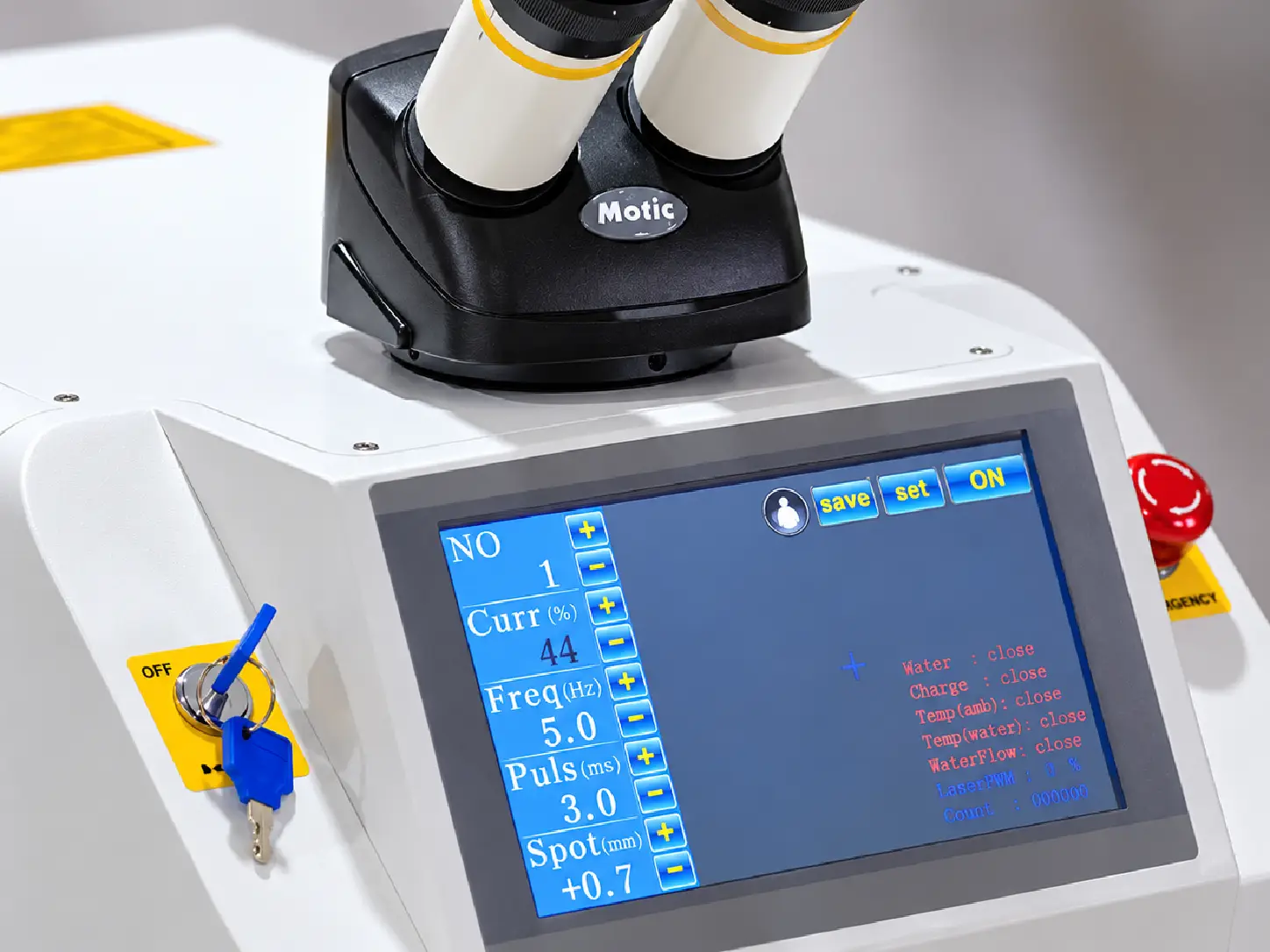
Different machines may display voltage, power percentage, pulse energy, or other controls.
These values are not necessarily interchangeable between equipment models.
A setting of 20% power on one machine does not mean the same delivered energy as 20% on another.
For a jewelry laser welding machine, consistent control and repeatable welding results are more useful than copying universal numbers from an unrelated machine.
3. How Does Gold Karat Affect Common Jewelry Repairs?
Gold purity affects welding behavior, but the actual repair often has an even greater influence on the required settings.
The same 18K alloy can require different welding conditions for a ring shank, chain link, and prong.
Ring Resizing and Shank Repairs
Ring-shank repairs require sufficient fusion across the joint.
Before welding, clean the metal, inspect previous repairs, and align the joint properly.
For a narrow seam, an appropriately focused spot can help establish penetration.
For a thicker shank, the operator may need to adjust energy delivery, prepare the joint differently, or add compatible filler metal.
Previous solder requires particular attention.
Some low-melting constituents in solder can interfere with laser welding and create porosity or brittle regions.
If the joint contains incompatible or contaminated solder, the affected material may need to be removed before rebuilding.
This applies to 10K, 14K, and 18K jewelry.
For white gold, inspect whether the original rhodium plating will need to be restored after the repair.
Fine Chain and Jump Ring Repairs
Fine chains require much more controlled energy delivery than heavy rings.
Because each link contains relatively little metal, a setting that produces good penetration in a ring shank may completely melt a chain connection.
Use a spot matched to the link size and begin with a conservative energy setting appropriate for the machine.
Confirm the joint is aligned before welding.
The alloy is still important, but wire diameter and joint geometry usually deserve attention before increasing energy based on karatage.
Gold-filled and plated chains may present additional problems because welding can expose or mix the underlying metal.
Not every damaged chain is a suitable candidate for laser repair.
Prong Retipping and Stone-Set Jewelry
Prong repair often involves attaching compatible filler metal to a small, worn area.
A narrow, controlled weld can help rebuild the prong without unnecessarily heating the surrounding setting.
However, the repair must be assessed carefully.
A worn but structurally sound tip is different from a prong that has cracked near its base.
For white gold prongs, alloy brittleness and previous solder repairs may also influence the result.
A laser welder for jewelry repair provides precise beam positioning, making it useful for detailed prong and bezel work.
Nevertheless, localized laser welding does not guarantee gemstone safety.
Heat-sensitive, treated, or damaged stones may need to be removed before welding. The specific stone and setting must be assessed individually.

4. How Do You Fix Common Gold Laser Welding Problems?
The most common problems when changing between 10K, 14K, and 18K gold are weak fusion, spatter, cracking, porosity, and visible color differences.
Identifying the actual problem is more useful than automatically increasing or decreasing the joule setting.
Welding Problem | Possible Cause | What to Check First |
|---|---|---|
Weak Fusion | Incorrect focus, low energy, poor joint fit | Focus, alignment, and penetration |
Spatter or Craters | Excessive energy concentration or volatile alloy components | Pulse settings and contamination |
Weld Cracking | Alloy sensitivity, residual stress, incompatible filler | Alloy, old solder, and joint condition |
Porosity or Black Spots | Contamination, unsuitable filler, shielding issues | Cleaning, filler, and gas delivery |
Visible Color Difference | Filler mismatch or altered surface finish | Alloy color and finishing requirements |
Why Does 18K Crack When 14K Welds Successfully?
If a 14K ring welds successfully but an 18K ring cracks with the same settings, start by identifying the exact material.
Is the 18K ring yellow gold, nickel white gold, palladium white gold, or rose gold?
Does the joint contain old solder?
Is the crack appearing in the weld metal or extending into the original material?
These details help identify whether the problem is related to the alloy, existing damage, or welding conditions.
For certain crack-sensitive alloys, a different pulse shape, compatible filler, or repair-joint preparation may be more effective than simply reducing energy.
If cracking continues, avoid repeatedly welding over the damaged area without correcting the underlying cause.
Why Does the Weld Turn Black or Develop Pinholes?
Black spots and pinholes can result from several different causes.
Possible sources include surface contamination, old solder, volatile alloying elements, or inadequate shielding.
Clean the joint and inspect the filler before changing the laser parameters.
Where the machine and process require argon shielding, verify the gas delivery and follow the manufacturer's recommendations.
If porosity continues in a previously soldered area, removing contaminated metal may be necessary.
How Do You Avoid Color Differences After Repair?
Color matching is particularly relevant when repairing 10K, 14K, and 18K gold.
Using filler with the same karatage does not always guarantee an identical color, because different manufacturers can use different alloy formulas.
Choose filler designed for the actual material and application.
Specialized laser welding wires may also be recommended for difficult white gold alloys.
After welding, the finished repair may require polishing or restoration of the original surface treatment.
For rhodium-plated white gold, the repair should be evaluated before replating so that plating does not conceal an unsound joint.
Conclusion
Laser welding 10K vs 14K vs 18K gold requires more than choosing three different power settings.
10K gold can present greater variation from alloying metals and may require extra attention to filler compatibility and color matching.
14K gold is common in everyday jewelry repairs, but chains, rings, and prongs still need different welding settings.
18K gold requires attention to the actual alloy, polished surface condition, delicate sections, and possible cracking in certain white gold compositions.
There is no reliable universal rule that 10K needs the highest energy and 18K needs the lowest.
The best results come from identifying the alloy, preparing the joint, testing the laser settings, and confirming proper fusion before completing the repair.
For professional jewelers, a controllable jewelry welder makes it easier to handle different gold alloys and repair types.
Our team can help recommend an appropriate machine configuration and discuss sample-welding tests for the gold alloys and repairs your business handles most frequently.