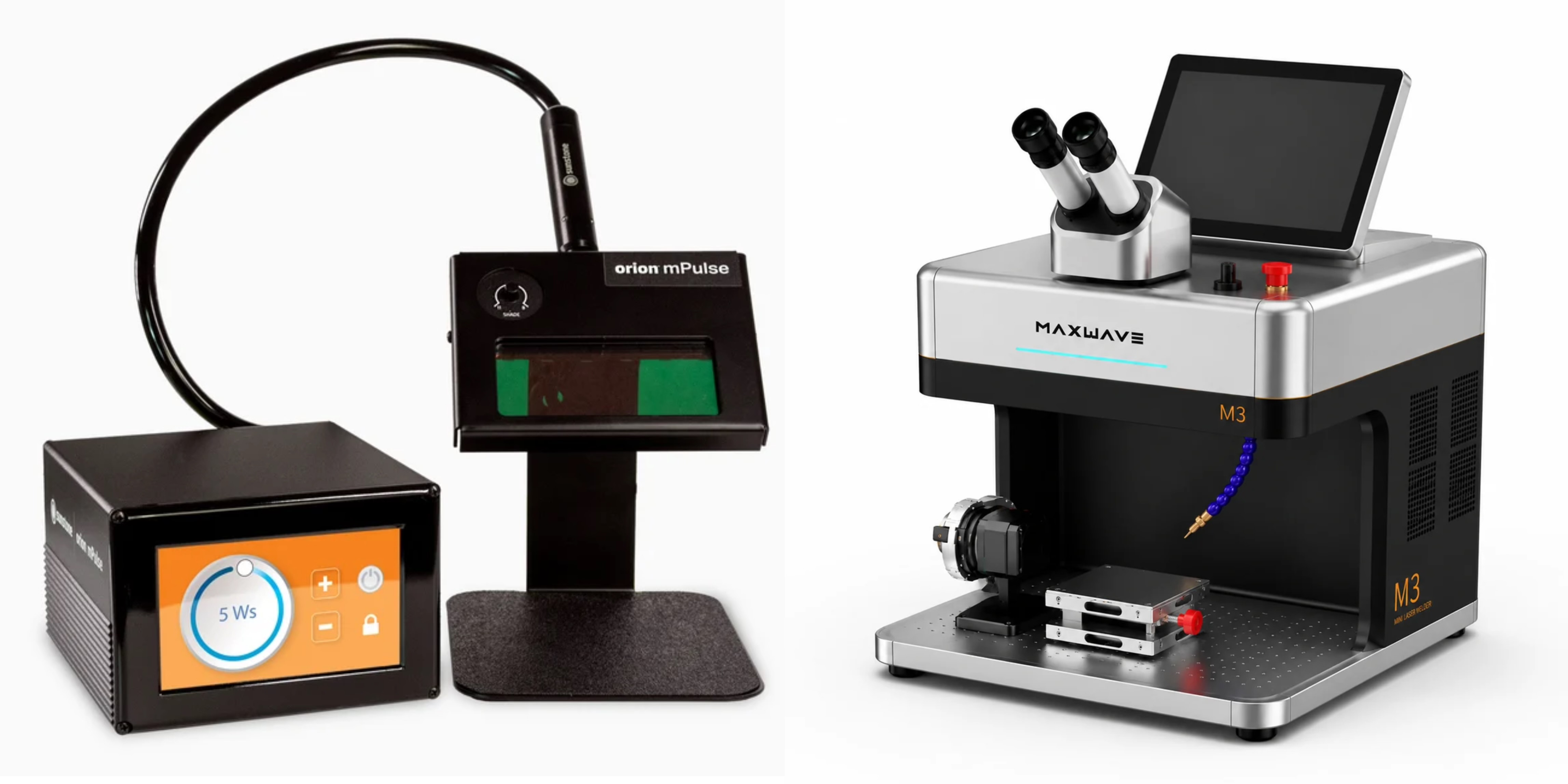
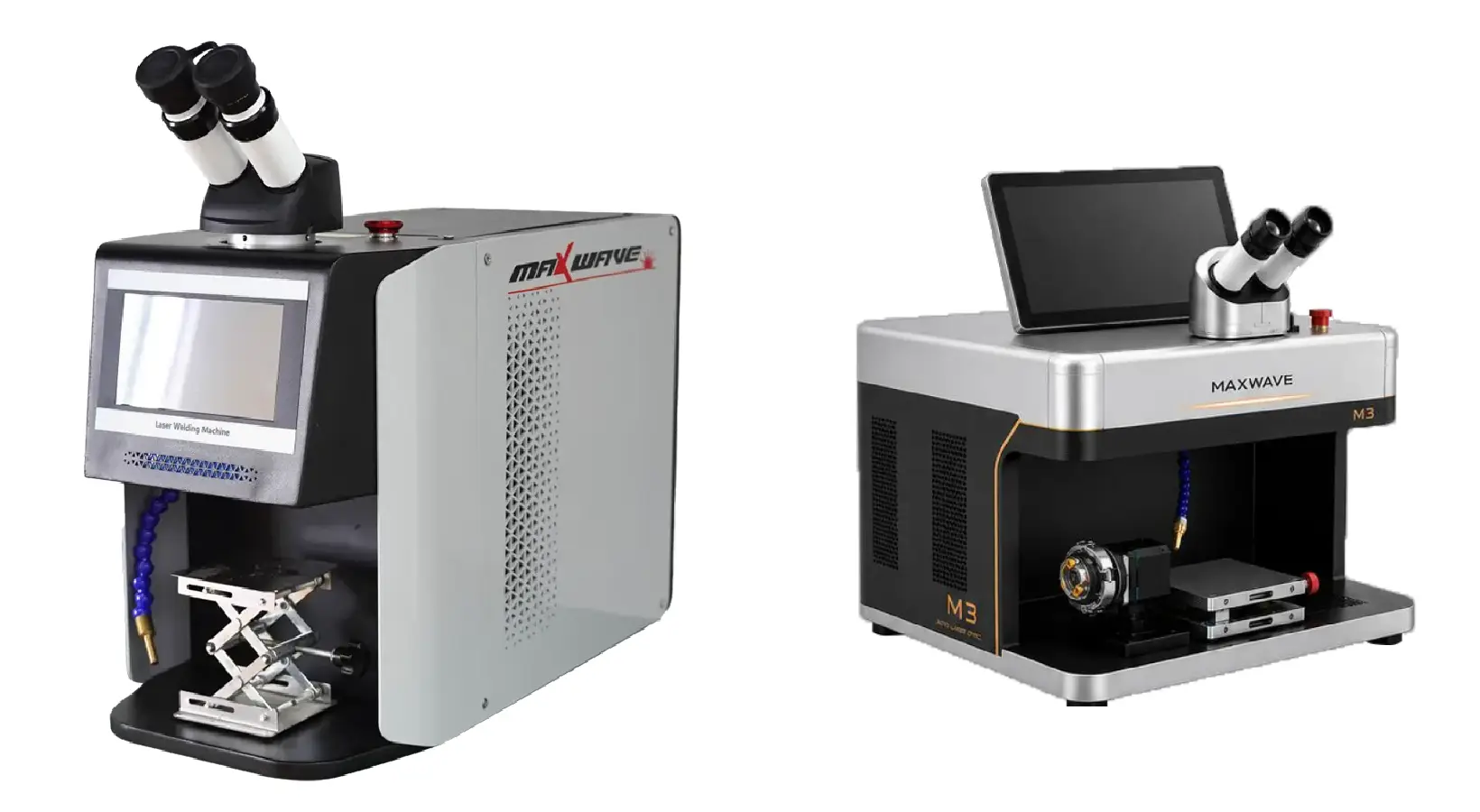
Pulse arc welders and jewelry laser welders can both repair and join precious metals, but they are designed around different welding methods and business priorities.
A pulse arc welder is often a practical, lower-investment option for basic jewelry assembly, jump ring closure, and certain routine repairs. A jewelry laser welder offers non-contact welding, adjustable beam control, and greater flexibility for intricate repairs, detailed metal restoration, and hard-to-reach areas.
If your workshop mainly closes simple chain links, a pulse arc welder may be sufficient. But if you regularly repair valuable rings, rebuild worn prongs, fill casting porosity, or work on complex custom pieces, a jewelry laser welder may provide the additional control your business needs.
So which one makes more sense for your jewelry shop?
This guide compares pulse arc and laser welding by repair application, precision, metal compatibility, equipment cost, and long-term business value.
1. Pulse Arc vs Jewelry Laser Welder: What Is the Difference?
The main difference is how each machine delivers energy to the metal.
A jewelry pulse arc welder, sometimes called a micro-TIG welder, uses a controlled electrical arc between a tungsten electrode and the workpiece. Depending on the machine, the operator positions or touches the electrode near the intended welding point to initiate a short electrical discharge.
A jewelry laser welder uses a focused laser beam to melt metal at a selected location without requiring an electrode to contact the workpiece. The operator typically positions the jewelry under a microscope or camera viewing system and controls the welding pulse.
Both methods can produce localized welds, but they offer different approaches to positioning, energy control, and accessing small jewelry components, as explored in our detailed pulse arc vs laser welder comparison.
Pulse Arc vs Laser Welder Comparison
Feature | Pulse Arc Welder | Jewelry Laser Welder |
|---|---|---|
Welding Method | Controlled electrical arc | Focused laser beam |
Workpiece Contact | Electrode must approach or touch the joint, depending on system | Non-contact beam delivery |
Precision | High, especially on professional micro-arc systems | Fine, adjustable optical targeting |
Spot Control | Often closely linked to welding energy | Spot size and pulse energy can typically be adjusted separately |
Hard-to-Reach Areas | Limited by electrode positioning | Accessible wherever the focused beam has a suitable optical path |
Heat-Affected Area | Localized; depends on settings and joint | Localized; depends on settings and joint |
Filler Metal | Can be used | Can be used |
Entry Cost | Generally lower | Generally higher |
Typical Applications | Jump rings, chain connections, assembly, repair | Precision repairs, prong rebuilding, porosity filling, custom fabrication |
Main Consideration | Electrode access and wear | Optical alignment, machine investment, and laser safety |
Both technologies can create strong and visually acceptable welds. Neither automatically guarantees better joint strength.
Weld quality depends on the metal alloy, penetration, joint design, welding settings, and operator experience.
The practical advantage of laser welding is greater flexibility in placing and controlling a weld without physically positioning an electrode against the joint.
2. Which Welder Works Better for Common Jewelry Repairs?
For most jewelry businesses, choosing equipment by actual repair tasks is more useful than comparing maximum power ratings.
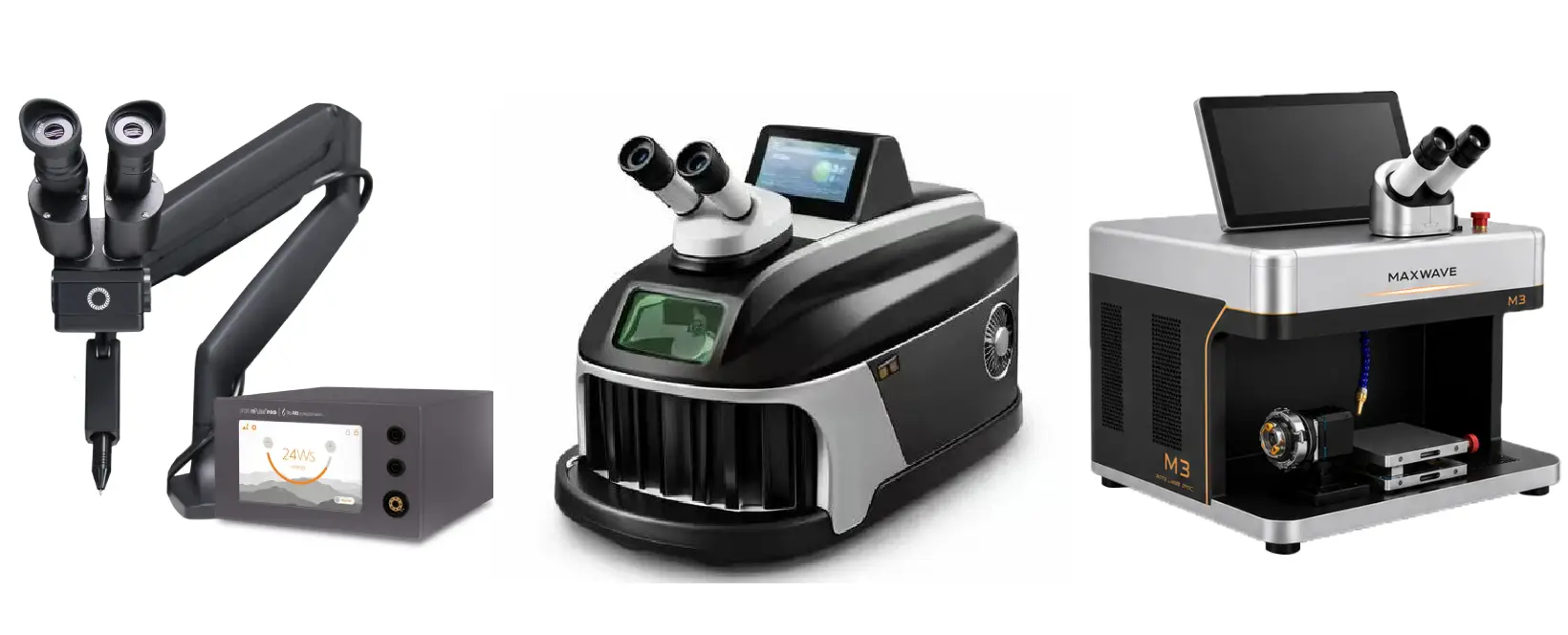
A jeweler repairing simple chains every day has different requirements from a goldsmith restoring antique rings or manufacturing intricate custom jewelry, which is why comparing our four laser welder models can help match equipment to workload.
Jewelry Repair Application Comparison
Jewelry Application | Pulse Arc Welder | Jewelry Laser Welder |
|---|---|---|
Simple jump ring closure | Often sufficient | Also suitable |
Basic chain repair | Good for accessible joints | Useful for fine or complex links |
Ring resizing | Suitable with correct technique | Particularly useful for controlled seam welding |
Prong retipping | Possible with professional systems | Well suited to precise metal buildup |
Repairs near gemstones | Possible after individual risk assessment | Helpful for optical targeting, with gemstone precautions |
Casting porosity repair | Possible with filler and suitable technique | Well suited to localized filling and surface restoration |
Complex filigree repair | Electrode access may be difficult | Non-contact beam can improve accessibility |
Custom jewelry fabrication | Suitable for many joining tasks | Flexible for detailed construction and repeated weld placement |
Permanent jewelry services | Often a practical choice | Usually unnecessary for simple on-body chain closure |
When Pulse Arc Welding Is Enough
Pulse arc welding is often a sensible choice when your workshop mainly performs straightforward joining tasks.
For example, closing jump rings, attaching accessible components, and making simple chain connections may not require the full capabilities of a laser welding system.
Professional pulse arc equipment can also support ring repairs, prong work, and metal buildup when the operator and equipment are suitable.
For a small business with limited repair complexity, a lower initial equipment investment may be more important than advanced welding flexibility.
When Jewelry Laser Welding Offers More Value
Laser welding becomes especially attractive when repair precision, joint accessibility, and surface appearance are important.
Consider a worn prong on a diamond ring, a small crack inside a detailed setting, or a casting with several tiny surface defects.
These jobs often require the operator to place multiple controlled welds in a small area without interfering with neighboring metal features.
A jewelry laser welding machine allows the operator to aim through the viewing system and adjust the welding spot and energy to suit the repair.
This can make complex metal restoration and cosmetic finishing more manageable.
For workshops regularly repairing expensive or highly detailed jewelry, that flexibility may justify a higher equipment investment.
3. Precision, Heat Control, and Metal Compatibility
Both pulse arc and laser welding concentrate energy into a relatively small area, unlike traditional torch soldering, which often heats a larger portion of the jewelry.
However, they differ in how the operator controls that energy and positions the weld.
Which Is Better for Fine Details?
Professional pulse arc welders can produce very small weld spots, particularly when equipped with microscope viewing and advanced energy control.
However, the electrode must still be positioned at the joint, which can make some recessed or obstructed areas difficult to access.
Laser welding uses optical targeting and does not require an electrode to physically reach the weld location.
Many jewelry laser welders also allow the operator to adjust spot diameter and pulse energy separately.
That flexibility can be valuable when moving between small prong tips, fine chain links, surface buildup, and larger ring seams.
For a workshop handling varied precision repairs, a laser welder for jewelry offers a useful combination of non-contact targeting and adjustable welding parameters.

Can You Weld Near Gemstones?
Both pulse arc and laser welding can be used for certain repairs near mounted gemstones, but neither method is automatically safe for every stone.
Laser welding can limit heat input to a small area and may allow some repairs to be completed without removing the stone.
However, the laser beam itself can damage a gemstone if it strikes the stone directly. Heat conduction through nearby metal can also cause damage.
Pulse arc welding avoids direct laser irradiation, but its electrical arc and localized heat still require careful positioning and control.
Before welding near a stone, consider:
Gemstone type and any known treatments.
Existing fractures, inclusions, or internal stress.
Distance between the weld and the setting.
Heat conduction through the surrounding metal.
Whether the stone can safely remain mounted.
Emeralds, opals, pearls, fracture-filled stones, and other sensitive materials may require particular caution.
Never assume that a gemstone can remain in place simply because you are using a laser welder. Some repairs still require stone removal or an alternative repair method.
Gold, Silver, and Platinum: Does the Metal Matter?
Yes. Different jewelry metals respond differently to electrical arcs and laser energy.
Gold: Both methods can weld many gold alloys. Laser welding is particularly useful for detailed gold repairs, prong rebuilding, and cosmetic restoration.
Silver: Silver's high thermal conductivity and reflectivity can make laser welding more demanding, especially with some 1064 nm systems. Pulse arc welding can be an effective alternative. However, suitable jewelry laser welders can also weld silver when properly configured.
Platinum: Both techniques can be used for platinum jewelry. Laser welding is useful for localized repairs and precision work, but adequate fusion and appropriate shielding remain important.
For either technology, welding settings should be developed around the actual alloy and joint.
Request sample welds on the materials your workshop uses rather than assuming one machine will perform equally well on every metal.

4. Equipment Cost, Maintenance, and Training
The purchase price is often the first difference buyers notice.
Pulse arc welders generally have a lower entry cost, while professional jewelry laser welders require a larger initial investment.
However, the cheapest machine is not necessarily the most economical choice over several years.
What Does Each Machine Cost to Maintain?
Pulse arc systems typically require electrode inspection, sharpening or replacement, shielding gas where specified, and routine maintenance of their electrical and viewing components.
Jewelry laser welders require maintenance of their optical components, protective viewing system, cooling arrangement where applicable, and other components specified by the manufacturer.
Maintenance costs vary with machine design, workload, and service arrangements.
When comparing suppliers, consider the complete ownership cost rather than relying on one advertised price.
Cost Factor | Pulse Arc Welder | Jewelry Laser Welder |
|---|---|---|
Initial Investment | Usually lower | Usually higher |
Regular Consumables | Electrodes, shielding gas, maintenance parts | Protective optics, shielding gas where required, model-specific service parts |
Training | Welding technique and electrode control | Optical positioning, parameter adjustment, and laser safety |
Workspace | Often compact | Depends on desktop or cabinet design |
Service Requirements | Vary by model | Vary by laser source and cooling design |
Business Value | Economical for suitable routine work | Broader possibilities for complex precision repairs |
Neither machine has a universal fixed payback period.
A jewelry shop's return depends on the repairs it can complete, the revenue those repairs generate, the labor involved, and how much work it currently sends to outside specialists.
When Is a Jewelry Laser Welder Worth the Investment?
A jewelry laser welder becomes more attractive when it enables your workshop to complete valuable jobs that are difficult, inefficient, or impractical with your existing equipment.
Consider these business questions:
How many precision repairs do you receive each month?
How often do you outsource prong rebuilding, casting restoration, or complex ring repairs?
How much time do you spend on additional finishing or correcting unsuccessful welds?
Could you accept more custom jewelry or high-value repair work with better welding capability?
How important are repeatable welding settings and operator training to your business?
For example, a shop that rarely needs more than jump ring closure may not benefit enough from investing in a professional laser system.
But a goldsmith regularly handling stone-set rings, detailed restorations, and custom fabrication may benefit from the wider range of work a jewelry repair laser welder can support.
The equipment should expand the services your business can reliably deliver—not simply add another machine to the workshop.

5. Which Machine Fits Your Jewelry Business?
The best choice depends on the work you handle now and the services you want to provide in the future.
Small Jewelry Shops and Permanent Jewelry Businesses
If your main work involves straightforward chain joining, accessible repairs, or permanent jewelry services, a suitable pulse arc welder may provide the capability you need at a lower initial cost.
For on-body permanent jewelry, use equipment and procedures specifically designed and approved for that service. A conventional bench jewelry laser welder should not be treated as a substitute for a purpose-built on-body welding setup.
If your business plans to expand into ring rebuilding, precision repairs, and custom fabrication, consider whether investing in a more versatile laser system would be worthwhile.
Professional Jewelry Repair Shops and Goldsmiths
For professional workshops handling different alloys, valuable pieces, detailed repairs, and complex settings, a jewelry laser welder is often the more flexible investment.
Its non-contact beam delivery and adjustable welding controls make it useful for tasks such as:
Rebuilding worn prongs and ring shanks.
Repairing fine jewelry connections.
Filling casting porosity and small surface defects.
Joining intricate custom jewelry components.
Welding in locations that are difficult to reach with an electrode.
A suitable desktop jewelry laser welder can help bring more precision repair work in-house and reduce dependence on external repair services.
Jewelry Manufacturers and Growing Workshops
For workshops producing custom jewelry in batches or performing repeated precision welds, consistency and workflow efficiency become increasingly important.
Look for a laser welding system with stable output, suitable cooling, clear microscope or camera viewing, convenient parameter adjustment, and support for repeatable welding procedures.
Depending on production volume, you may also want to compare conventional pulsed Nd jewelry welders with QCW laser welding configurations.
The best option depends on material type, joint requirements, machine workload, and available technical support.
Before purchasing, test representative jewelry samples and confirm that the machine can reproduce acceptable weld quality throughout your intended workflow.
At JewelryWelderPro, buyers can compare jewelry laser welding equipment for repair shops, goldsmith studios, and manufacturing applications, including different desktop and higher-workload configurations.
Conclusion
Pulse arc welders are practical for many routine jewelry joining tasks, while jewelry laser welders provide greater flexibility for detailed repairs, complex structures, and non-contact welding applications.
If your business mainly performs simple chain closures or occasional accessible welds, a pulse arc machine may be enough.
However, if you regularly repair valuable jewelry, rebuild worn prongs, restore casting defects, or create detailed custom pieces, investing in a jewelry laser welder can help expand your workshop's capabilities.
The right decision should be based on the repairs you perform, the metals you work with, and the level of precision your customers expect.
Not sure whether your workshop needs a jewelry laser welder? Contact JewelryWelderPro to discuss your typical repairs, materials, and production requirements. Our team can help you compare suitable laser welding machines, evaluate sample welding applications, and choose equipment that fits your business needs.