For most jewelry repair shops buying a new machine, an air-cooled QCW jewelry laser welder is the better overall choice. It can handle common ring, chain, and prong repairs while offering simpler maintenance, higher energy efficiency, and no flashlamp replacement.
A traditional Nd laser welder remains a proven option, especially for jewelers who already have experience with YAG equipment or need a particular machine's pulse-energy capabilities.
Both technologies can produce precise, high-quality welds. The reason to recommend QCW for most new buyers is its combination of repair versatility and easier long-term operation, provided the selected machine performs well on the shop's actual jewelry.
If you are comparing a jewelry laser welder, the following guide shows which technology makes more sense for your repair work.
Workshop or Repair Need | Better Choice | Why |
|---|---|---|
New jewelry repair shop | QCW | Versatile repairs with simpler daily maintenance |
Daily ring, chain and prong repairs | QCW | Efficient operation without flashlamp replacement |
Existing YAG workshop | Keep YAG if it meets your needs | Avoid unnecessary replacement costs |
Heavy rings and platinum | Compare actual machines | Pulse energy and penetration matter more than laser type |
Specialized precision repairs | Compare sample welds | Actual spot and pulse control determine results |
The choice becomes clearer when you compare how the machines weld, what they cost to maintain, and the types of repairs your workshop performs most frequently.
1. How Are YAG and QCW Jewelry Laser Welders Different?
The main difference between YAG and QCW is the laser source. Both can deliver controlled pulses for precision jewelry welding, but their cooling systems, maintenance needs, and operating efficiency differ.
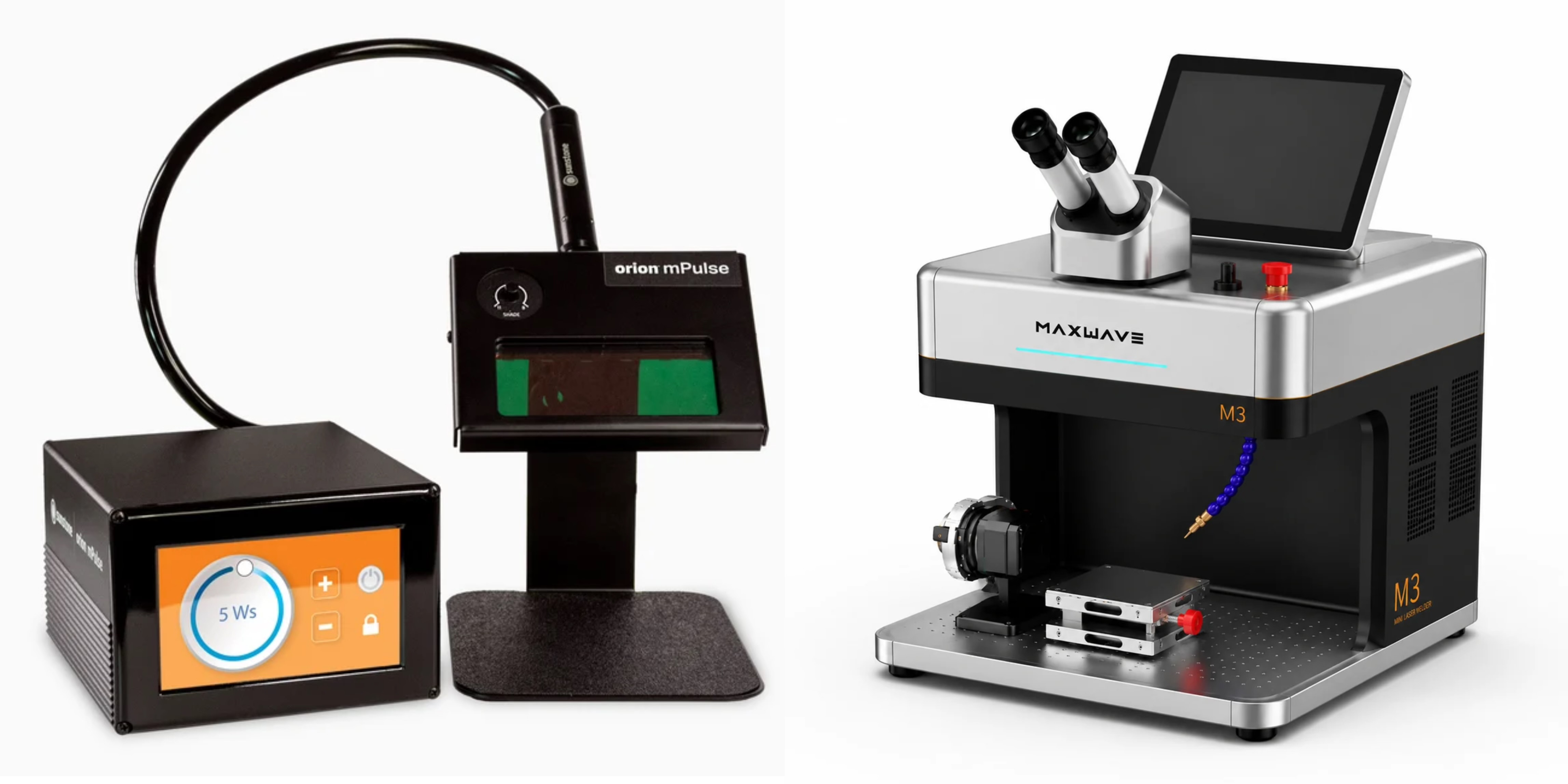
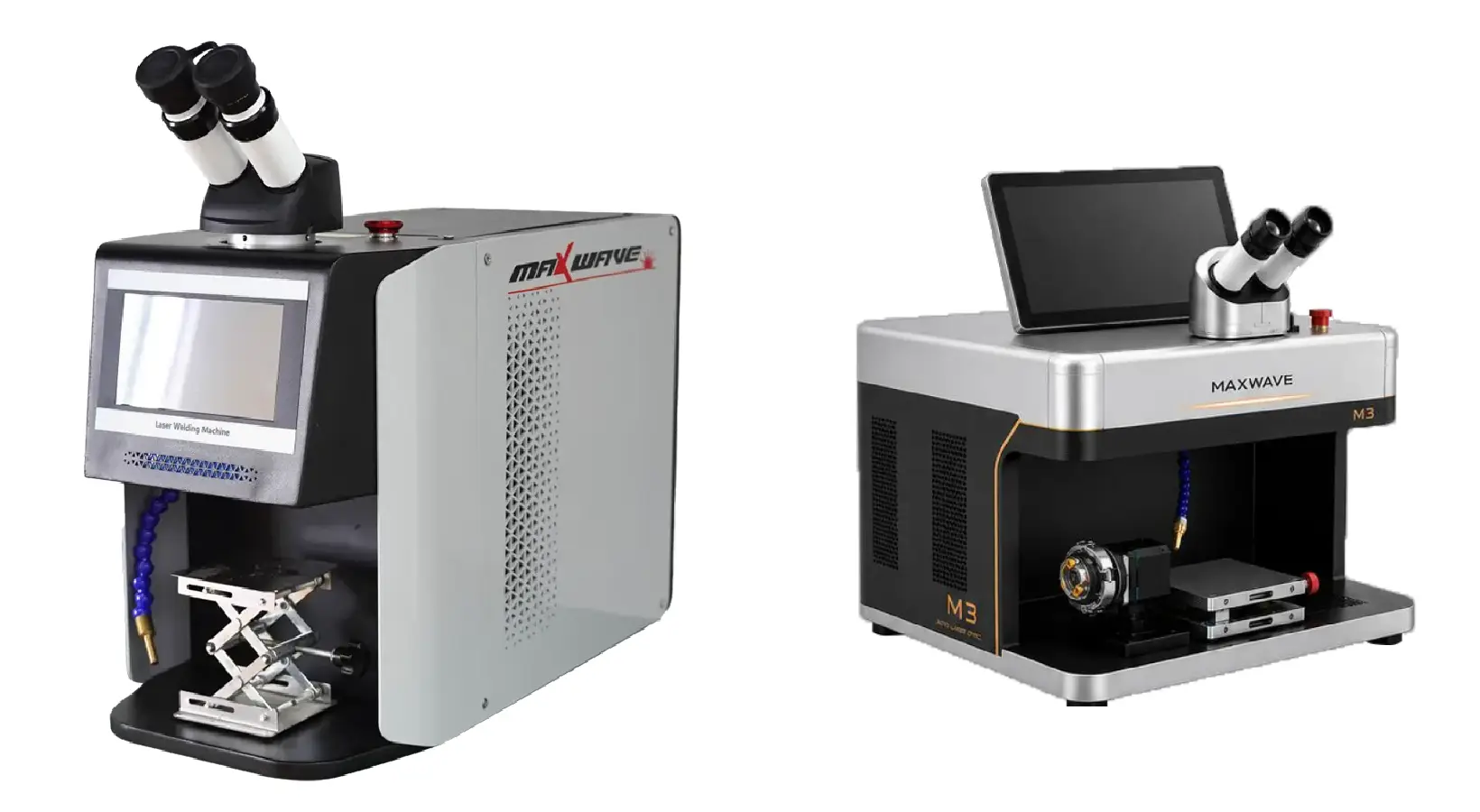
A traditional Nd jewelry laser welder uses a solid-state laser crystal, commonly pumped by a flashlamp. Most conventional lamp-pumped YAG machines use water cooling and require periodic flashlamp replacement.
QCW stands for Quasi-Continuous Wave. A QCW fiber laser uses a diode-pumped fiber source to produce high-power pulses suitable for localized metal welding. Unlike traditional YAG systems, QCW fiber lasers do not require flashlamp replacement.
QCW is also different from ordinary continuous-wave laser welding. It can deliver controlled millisecond pulses for precision repair work.
Why QCW Has an Advantage for Daily Use
Air-cooled QCW configurations eliminate the need for the water-cooling circuit found on many traditional YAG machines.
This simplifies routine maintenance and can make installation easier for jewelry workshops with limited space.
QCW fiber sources also generally offer higher electrical efficiency than conventional flashlamp-pumped YAG systems.
For a workshop using its welder throughout the day, these advantages can reduce operating costs and routine maintenance demands.
However, QCW does not automatically produce a smaller weld spot, deeper penetration, or less heat damage than every YAG machine.
Both technologies can achieve localized welding when their pulse settings are appropriate.
The main advantage of QCW for most new buyers is easier daily ownership, combined with the ability to perform the jewelry repairs they need.
When evaluating a jewelry laser welding machine, compare adjustable pulse energy, pulse width, spot size, and actual welding results rather than relying on advertised wattage alone.

2. Which Performs Better for Common Jewelry Repairs?
For most jewelry workshops, ring repairs, prong retipping, and broken chains make up a substantial part of daily welding work.
Both YAG and QCW can handle these applications. The differences become more relevant when you consider repair complexity, required precision, and how frequently the machine operates.
Prong Retipping and Stone-Set Jewelry
Prong retipping requires precise welding in a small area, often close to gemstones or delicate settings.
The operator may need to attach compatible filler metal, rebuild a worn tip, or reinforce a small joint without unnecessarily melting the surrounding metal.
A suitable YAG machine can perform these repairs using controlled pulse energy and a small focused spot. Traditional YAG welders have been widely used for detailed jewelry repair for many years.
A QCW machine can perform the same tasks when it offers stable low-energy pulse control, suitable spot-size adjustment, and accurate microscope positioning.
For a repair studio handling many prong repairs each day, QCW is often the better overall purchase because it combines the required welding capability with lower routine maintenance.
This advantage becomes more useful when the machine is operated frequently.
However, QCW is not inherently safer near gemstones. The actual risk depends on the laser settings, weld position, metal construction, and gemstone type.
Heat-sensitive, treated, or damaged stones may require removal before welding.
For a professional laser welder for jewelry repair, accurate positioning, consistent pulse delivery, and clear microscope visibility matter more than the laser source label.
Ring Resizing and Shank Rebuilding
Ring repairs require enough welding energy to produce reliable fusion across the joint.
For thin ring shanks, excessive energy can cause cratering or unnecessary melting. For heavier rings, insufficient energy may create a shallow weld that looks smooth but lacks adequate penetration.
Some traditional YAG machines offer substantial single-pulse energy reserves, making them suitable for thicker joints and metal buildup.
QCW machines can also handle these repairs when their available pulse energy and spot characteristics meet the requirements of the joint.
Therefore, YAG should not automatically be considered better for thick rings, and QCW should not be viewed as equipment intended only for delicate jewelry.
For ordinary gold ring resizing and shank repairs, both technologies can work effectively.
For a new workshop performing these repairs regularly, QCW remains the preferred overall choice when sample welds confirm adequate penetration and strength.
For unusually thick rings or demanding platinum repairs, compare the actual pulse capabilities and welding results of the machines under consideration.
A higher average-power rating does not automatically mean deeper welding. Pulse energy, pulse width, spot size, and joint preparation all influence the result.
Fine Chains and Small Components
Fine chains and jump rings contain relatively little metal, making them sensitive to excessive welding energy.
Both YAG and QCW systems can produce small, localized welds when properly configured.
The operator needs a controllable spot size, suitable pulse energy, and accurate positioning to avoid burning through the link.
For a repair shop that occasionally welds broken chains, an existing YAG machine may already provide satisfactory performance.
For a workshop welding numerous chains, clasps, or small components each day, QCW becomes more attractive.
Its lower routine maintenance requirements and efficient fiber laser architecture make it a practical choice for frequent, repeated welding.
However, actual productivity still depends on machine configuration, working-area access, and operator technique.
A QCW welder with poor microscope visibility or limited pulse adjustment is not automatically better than a well-configured YAG system.
What About Gold, Silver, and Platinum?
Material differences matter regardless of the laser source.
Gold welding behavior depends on karatage and alloy composition. White, yellow, and rose gold may need different settings.
Silver is highly reflective and conducts heat rapidly, making suitable energy delivery and surface preparation particularly important.
Platinum has a higher melting temperature and may require greater fusion energy for heavy joints.
Both YAG and QCW can weld these precious metals when their performance matches the application.
For general gold, silver, and platinum repairs, QCW is a strong all-around choice for new buyers. For unusual alloys or heavy structural repairs, verify the selected machine through sample welding rather than assuming its technology guarantees the result.

3. Which Costs Less to Operate and Maintain?
The purchase price is an important consideration, but maintenance and operating expenses can influence the total cost over several years.
This is where air-cooled QCW machines offer a clearer practical advantage over many traditional YAG systems.
YAG Cooling and Maintenance
Conventional flashlamp-pumped YAG welders commonly use water cooling.
The operator must maintain the cooling system, monitor coolant condition, and inspect related components.
Flashlamps also require replacement after a certain amount of use, depending on the design and operating conditions.
These requirements add recurring maintenance tasks and can create downtime when replacement parts are unavailable.
However, YAG remains a practical option when the workshop already owns suitable equipment, has trained operators, and can obtain reliable technical support.
A well-maintained YAG machine does not need to be replaced simply because QCW technology is available.
QCW Cooling and Maintenance
Air-cooled QCW fiber welders eliminate flashlamp replacement and water-cooling maintenance.
Their higher electrical efficiency can also reduce energy consumption compared with traditional lamp-pumped YAG designs.
This makes QCW particularly attractive for workshops operating their equipment every day.
However, QCW systems still require routine inspection of protective optics, cooling-air passages, electrical connections, and the welding head.
Long-term reliability also depends on component quality and the availability of technical support.
Which Offers Better Long-Term Value?
For a new buyer, QCW is often the stronger long-term investment when its purchase price and welding performance are competitive.
Its reduced routine maintenance is valuable for busy repair shops and production environments.
YAG may still be more economical when the initial price is substantially lower, usage is limited, or the workshop already has a reliable machine and an established service arrangement.
Before purchasing, compare the complete ownership cost, including equipment, cooling, electricity, consumables, maintenance, warranty coverage, and potential downtime.
For jewelry repair businesses, the most cost-effective machine is the one that completes the required repairs reliably while keeping equipment and operating expenses manageable.
4. Which Jewelry Laser Welder Should You Buy?
For most workshops purchasing a new machine, air-cooled QCW is the recommended starting point.
However, different business situations can change the decision.
New and Busy Jewelry Repair Shops: Choose QCW
For a shop planning to handle ring resizing, prong retipping, broken chains, and general precious-metal repairs, an air-cooled QCW machine is an attractive all-around investment.
It provides the pulse-based welding capability required for these applications without the flashlamp maintenance associated with traditional YAG equipment.
This combination is particularly useful for workshops expanding their in-house repair services.
A suitable QCW system can also reduce the need for cooling-system maintenance, making daily operation more convenient.
For new buyers, prioritize a machine with precise pulse adjustment, suitable spot-size control, good microscope visibility, and reliable after-sales support.
Existing YAG Workshops: Replace Only When Necessary
If your workshop already owns a YAG welder that performs its normal repair work reliably, switching to QCW may not provide enough immediate benefit to justify the investment.
An existing YAG machine remains useful for ring repairs, chains, prongs, and precious-metal restoration.
Replacement becomes more attractive when flashlamp maintenance, cooling-system problems, equipment downtime, or increased production demand begin affecting operations.
For these buyers, QCW may be a practical upgrade rather than an urgent replacement.
Specialized Repairs: Compare Actual Welding Results
For heavy platinum joints, unusual alloys, or demanding structural repairs, do not choose a machine solely because it is labeled YAG or QCW.
Compare the usable pulse energy, spot diameter, pulse duration, and actual weld penetration.
A YAG machine with suitable high-energy pulse capabilities may outperform a particular low-power QCW model on a heavy joint.
A higher-capability QCW machine may achieve equally suitable results while offering easier maintenance.
Before purchasing either type of laser welder for jewelry, request sample welding on representative parts.
For example, use a fine chain link to evaluate low-energy control, a gold ring-sizing seam to assess ordinary repair performance, and a thicker precious-metal joint to verify penetration.
Inspect the welds for fusion, spatter, cracking, and finishing quality. For structural repairs, use an appropriate method to verify joint integrity rather than judging appearance alone.
The goal is to confirm that the machine can perform the work your shop needs under normal operating conditions.
Conclusion
YAG vs QCW jewelry laser welder: which is better for jewelry repair?
For most jewelry repair shops purchasing a new machine, an air-cooled QCW jewelry laser welder is the better overall choice.
It can handle common ring, chain, prong, and precious-metal repairs while offering simpler maintenance, higher electrical efficiency, and no flashlamp replacement.
This makes QCW particularly attractive for busy goldsmiths, retail jewelry repair shops, and manufacturers that use laser welding equipment regularly.
Traditional Nd remains a proven option, especially for workshops with existing YAG equipment, established maintenance support, or repair requirements that favor a particular machine's pulse capabilities.
Neither technology automatically produces better welds in every application.
For most new buyers, however, QCW offers the more convenient combination of everyday welding versatility and lower routine maintenance.
Our team can help you compare suitable YAG and QCW configurations and arrange sample welding so you can evaluate the results before choosing equipment.